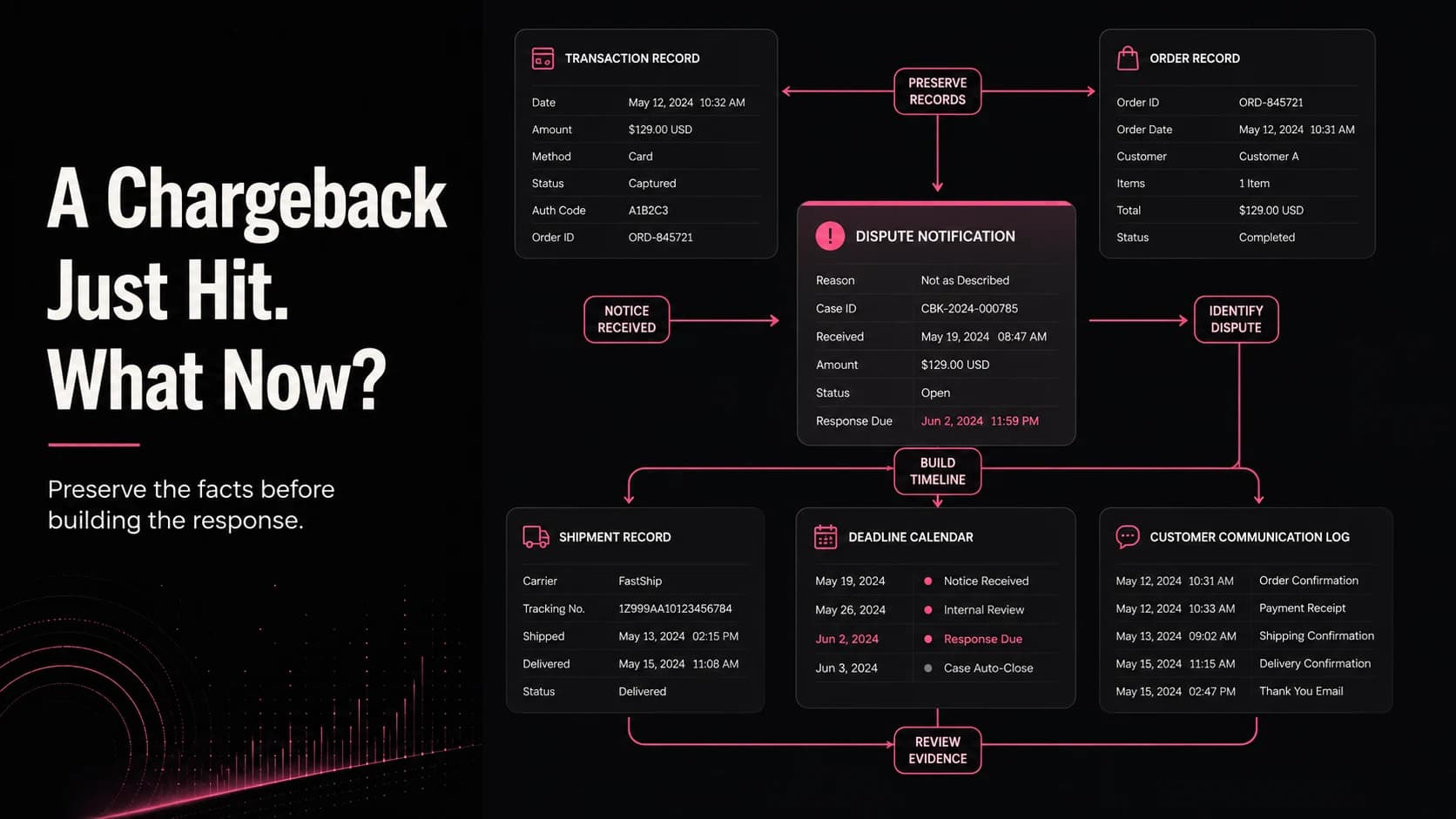
A chargeback notification creates urgency, but the fastest response is not always the strongest response. Merchants often lose useful context by immediately uploading whatever screenshots are easiest to find. A better first move is to preserve the record, identify what the cardholder is alleging, and then build a compact evidence package around that allegation.
The exact interface and filing window depend on your processor, acquiring bank, card network, and dispute category. Use the deadline shown in your merchant dashboard as the date that controls your internal workflow, and verify any network-specific rule against current official documentation before you submit.
1. Capture the dispute notice before anything else changes
Save the full notice, not just the headline. Capture the disputed amount, transaction date, reason category or reason code, response deadline, order identifier, cardholder descriptor, and any processor notes. A PDF export is ideal when available; otherwise keep screenshots plus the raw transaction ID.
At the same time, export the order record, fulfillment record, tracking status, support conversation, refund history, login or usage logs, and any version of your terms that applied on the purchase date. Some systems retain these indefinitely, while others overwrite status pages or rotate logs.
2. Translate the allegation into one sentence
Before collecting evidence, write one plain-English sentence describing what the cardholder is claiming. Examples include “the item never arrived,” “the product was materially different from the listing,” “the subscription was canceled before renewal,” or “the cardholder says they did not authorize the purchase.”
That sentence becomes the filter for every attachment. If a document does not help prove or disprove that allegation, it may be noise. A tight package is easier for a reviewer to follow than a folder containing twenty unrelated screenshots.
3. Build a transaction timeline
Put the events in chronological order: checkout, authorization, confirmation email, fulfillment, delivery, customer contact, cancellation request, refund action, and dispute notification. Include dates and times where the records support them. If there is a gap in the timeline, identify it instead of writing around it.
A timeline is especially useful when a dispute involves subscription renewals, delayed shipping, partial refunds, or a customer who continued using a digital service after requesting cancellation.
4. Separate proof from explanation
Evidence proves facts; the rebuttal explains why those facts answer the dispute. Tracking scans, signed delivery, login records, customer acknowledgements, product specifications, cancellation timestamps, and refund receipts are evidence. Your written summary should point the reviewer to those facts rather than repeat them in vague language.
Avoid emotional arguments about the customer being dishonest. A reviewer needs a documented transaction story, not a character judgment. State what happened, cite the record, and keep the sequence easy to audit.
5. Decide whether the case is worth contesting
Not every chargeback should be fought. If your own records show that a refund was owed, delivery failed, the billing descriptor was misleading, or a cancellation request was mishandled, accepting the dispute may be cheaper than spending staff time on a weak case.
For repeat dispute categories, record the root cause even when you accept the loss. The long-term value of the workflow is not only winning individual representments; it is finding the process failures that create preventable disputes.
Example: the first hour after a $420 non-receipt dispute
Suppose the processor notice arrives at 10:15 a.m. for an order shipped six weeks earlier. The warehouse page now says delivered, but the carrier's public tracking view no longer shows the full scan history and the support team has an open ticket from the customer. The first-hour task is not to write a rebuttal. Export the dispute notice, carrier history, order record, and support thread before any of those systems change.
Next, write the allegation as 'customer says the order was not received' and build the timeline around that sentence. If the support ticket reveals the customer actually reported a damaged item after delivery, that contradiction changes the evidence strategy. The dispute team should flag it rather than submit a generic delivery screenshot and hope the reviewer infers the rest.
A second-pass review before anyone writes the rebuttal
After the evidence has been frozen, run a second pass that asks whether the merchant is looking at the same transaction story the issuer is looking at. Match the amount, date, descriptor, order identifier, and disputed reason shown in the processor notice to the merchant's own records. This sounds basic, but it catches surprisingly consequential mistakes: a support agent may open the replacement order instead of the original order, a split shipment may create two fulfillment records, or a partial refund may make the disputed amount differ from the original sale. If those details do not reconcile, stop. A polished rebuttal built on the wrong transaction is worse than a short delay spent identifying the correct record.
Next, separate facts that existed before the dispute from material created after the dispute arrived. Checkout records, carrier events, authorization data, account logs, and support messages are contemporaneous. A newly written internal summary is not. That does not make the summary useless, but it should function as a map to the underlying records rather than as proof by itself. When a fact matters, preserve the source record that establishes it. If the team has to infer something—for example, that two login events probably came from the same user—label that as an inference rather than presenting it as a certainty.
The final first-hour question is whether the merchant has already changed the customer's economic position. Search for refunds, voids, reversals, replacement shipments, store credit, coupon adjustments, reshipments, or manual credits. These events frequently sit in different systems from the original payment. A dispute packet that ignores a completed remedy can accidentally defend money the customer no longer owes, while a team that notices the remedy can narrow the case to the amount actually at issue. This reconciliation also protects against double loss when a refund and a chargeback cross in time.
Use a simple ownership handoff before the first hour ends. One person should own the live processor deadline, one should gather missing operational records, and one should approve the final position if the amount or account risk is material. The point is not bureaucracy; it is to prevent the common failure where everyone assumes someone else has answered the case. Record the internal due date earlier than the processor due date, note any missing evidence explicitly, and leave enough time for a second reviewer to check that the narrative, exhibits, and amount all tell the same story.
A useful final check is to compare every item in the packet with the processor notice rather than with the merchant's memory of the sale. The notice defines the disputed transaction, amount, date, and allegation that the reviewer will evaluate. If the internal timeline contains a different capture amount, a later replacement order, a partial refund, or a second shipment, label those events explicitly instead of assuming the reviewer will infer the relationship. This catches a common first-hour mistake: submitting accurate records that belong to the wrong transaction state. It also gives the case owner a clean way to explain why a later event matters without rewriting the history. The objective of the first response is therefore not to collect the largest file set; it is to preserve the right record and make each later piece of evidence traceable to the exact disputed charge.
VERIFY CURRENT RULES
Primary references
Processor interfaces, reason-code mappings, filing windows, and network rules can change. Check the active dispute notice and current official documentation before submitting.