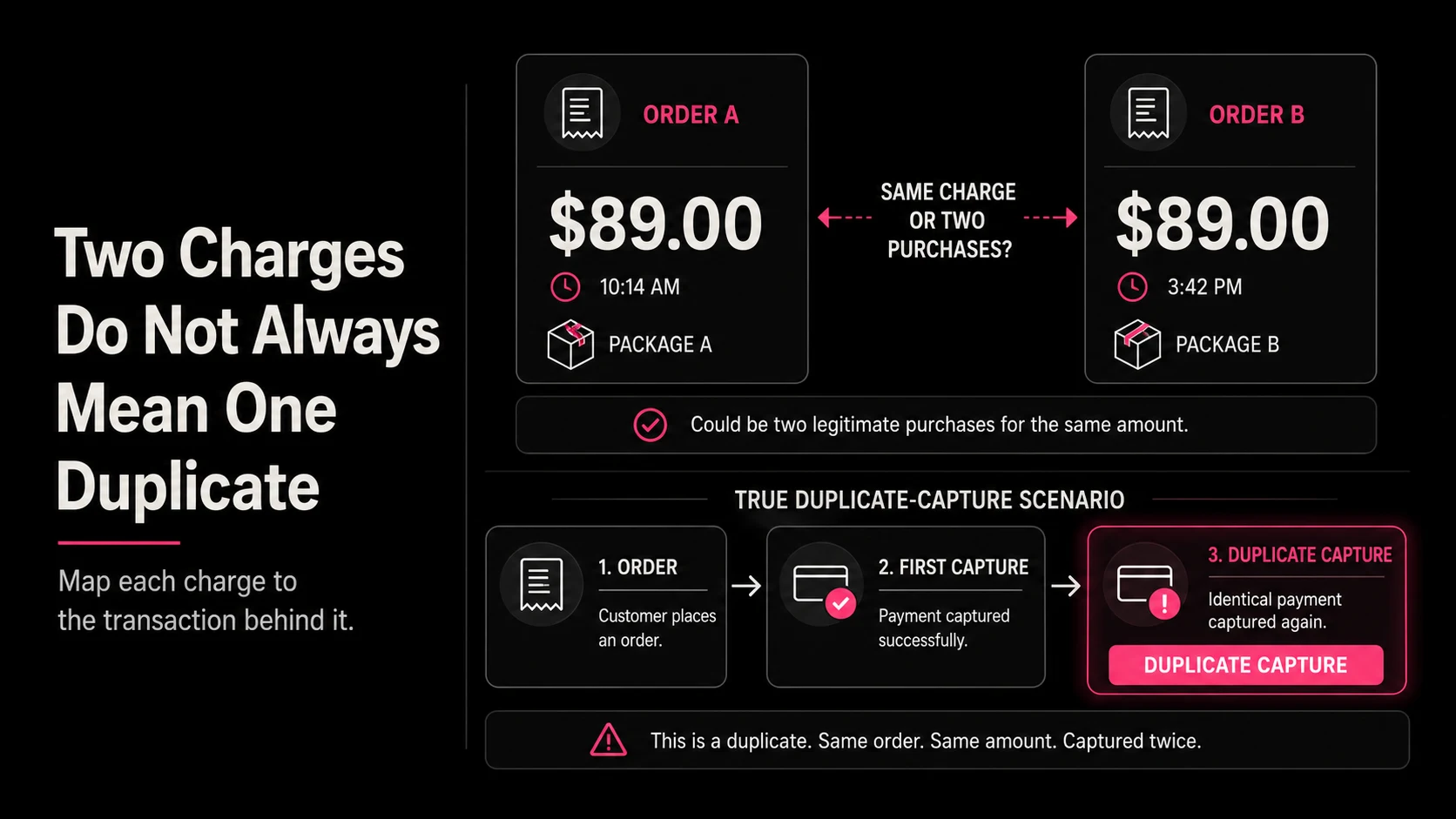
A duplicate-charge dispute asks a narrow question: are there two separate legitimate obligations, or did the merchant bill the same obligation twice? The strongest evidence is a one-to-one map between each charge and the underlying order or service.
This category is also a useful internal-control test. Checkout retries, webhook duplication, manual captures, and staff error can produce genuine duplicate charges. A merchant should verify the payment architecture before contesting the customer’s claim.
Create a two-column transaction map
List the disputed charge next to the charge the customer says is the duplicate. For each, record the processor transaction ID, authorization or capture time, amount, order ID, invoice, items or service, and fulfillment outcome.
If the two charges belong to different orders, the distinction should be visible immediately. If they trace back to one order, investigate whether the payment was captured twice.
Explain split captures and installments
Some merchants bill deposits and balances, capture items as they ship, or use installment schedules. These can look duplicated when the cardholder sees similar amounts or descriptors. Attach the purchase terms and invoice schedule that explain why multiple charges were expected.
Do not rely on internal labels such as “capture 2.” Translate the structure into customer-facing terms.
Use fulfillment to distinguish separate purchases
Two orders with separate confirmation emails, shipment numbers, delivery events, or service appointments are easier to distinguish than two lines in a payment export. Tie each charge to what the customer received.
If the buyer placed two identical orders minutes apart, include checkout or order history showing both submissions and any customer communication acknowledging the second order.
Recognize a real duplicate quickly
If your records show the same order was unintentionally captured twice, the correct operational response is normally to reverse the duplicate through your processor and fix the underlying bug or workflow. Contesting a true duplicate consumes time and can damage dispute metrics.
Record the root cause: retry behavior, idempotency failure, staff action, or reconciliation mistake.
Distinguish a true duplicate from two similar legitimate charges
Compare order IDs, timestamps, authorization/capture references, item or service records, and fulfillment for both postings. Two charges with the same amount are not automatically duplicates, but two processor IDs are not automatically separate purchases either. The commercial obligation behind each charge must be visible.
If a retry, API timeout, terminal double-submit, or batch process created a second charge for the same obligation, correct the customer balance first. Then tag the technical cause so the payments team can prevent recurrence instead of treating a genuine duplicate as a representment opportunity.
Example: two $89 charges that are not the same transaction
A customer buys one item on Monday and a different item on Thursday, each priced at $89. The statement shows two identical amounts and the customer disputes one as duplicate. The merchant should place the charges side by side with separate order IDs, timestamps, authorization references, and fulfillment records. The identical amount is only a visual similarity; the underlying obligations are different.
Contrast that with a checkout timeout that submits the same order twice within seconds and creates two captures against one order. In that case, two processor IDs do not make two legitimate purchases. The merchant's own order and fulfillment record exposes the duplicate, so the correct operational action is to correct the overcharge and fix retry/idempotency handling.
Use transaction IDs to distinguish a true duplicate from two purchases
Start with processor transaction IDs, authorization references, timestamps, amounts, order IDs, and fulfillment for both charges. Two identical amounts minutes apart can still be separate purchases; two different order records can also point back to one accidental retry. The response should make the relationship visible instead of asking the reviewer to infer it from matching receipts.
If only one commercial obligation exists and the second capture has no independent order or delivery, fixing the duplicate is usually the operational priority. If two legitimate purchases exist, document the separate basket, customer action, and fulfillment for each one.
Reconcile duplicate-looking charges at the settlement level
Start by distinguishing two legitimate purchases from one obligation processed twice. Create a row for every charge showing order ID, transaction ID, authorization time, capture or settlement time, amount, items or service purchased, and fulfillment outcome. If two $89 charges belong to two different orders, the merchant should be able to show two separate commercial events. If both charges point to one checkout and one fulfillment record, the processor IDs alone do not make both charges legitimate. The accounting relationship to the customer's obligation is what matters.
Do not stop at authorizations. Pending authorizations can disappear, be reversed, or be replaced by a later settled transaction. A customer may perceive two pending lines as a duplicate even though only one ultimately settles; the opposite can also happen when a retry or integration error creates two captures. Reconcile the processor's final status for each event and identify any void or reversal. If the business uses incremental authorizations, tips, deposits, or delayed capture, explain those mechanics only as far as the actual records show them.
Retry behavior deserves special attention in ecommerce. Browser refreshes, webhook retries, payment-provider retries, and poorly implemented idempotency can create accidental duplicate captures. If the merchant discovers that both charges came from one order, the right response is not to construct two artificial purchase stories. Correct the duplicate, document the refund or reversal, and open an engineering or process issue so the same failure cannot recur. Chargeback operations should feed defect prevention rather than hide a system problem.
When the charges are genuinely separate, make the distinction visible. Side-by-side order confirmations, separate timestamps, different item lists, independent shipping records, or distinct service appointments can demonstrate that the customer incurred two obligations. Avoid flooding the packet with every record for both orders. Select the few documents that prove separateness. The reviewer should be able to answer one question quickly: are these two different purchases that happen to look similar on a statement, or one purchase processed twice?
Distinguish duplicate authorization holds from duplicate settled charges
Customers often describe two visible card entries as duplicates even when one is only an authorization that later releases. The merchant should identify whether each entry was authorized, captured, settled, reversed, or refunded. A processor screenshot that shows two transaction IDs is not enough. If only one capture settled, explain the second event using the processor status and do not promise the exact date on which the issuer will remove a hold. If two captures settled, investigate the commercial obligation instead of hiding behind the presence of two authorizations.
The internal control should monitor both kinds of confusion. Duplicate authorizations can create customer support volume even without a financial overcharge, while duplicate captures create real loss. Improve checkout messaging around retries and pending payments, and reconcile repeated attempts to one order. A strong dispute response starts with settled-money truth, but a strong customer experience prevents ambiguous payment states from reaching the issuer in the first place.
VERIFY CURRENT RULES
Primary references
Processor interfaces, reason-code mappings, filing windows, and network rules can change. Check the active dispute notice and current official documentation before submitting.