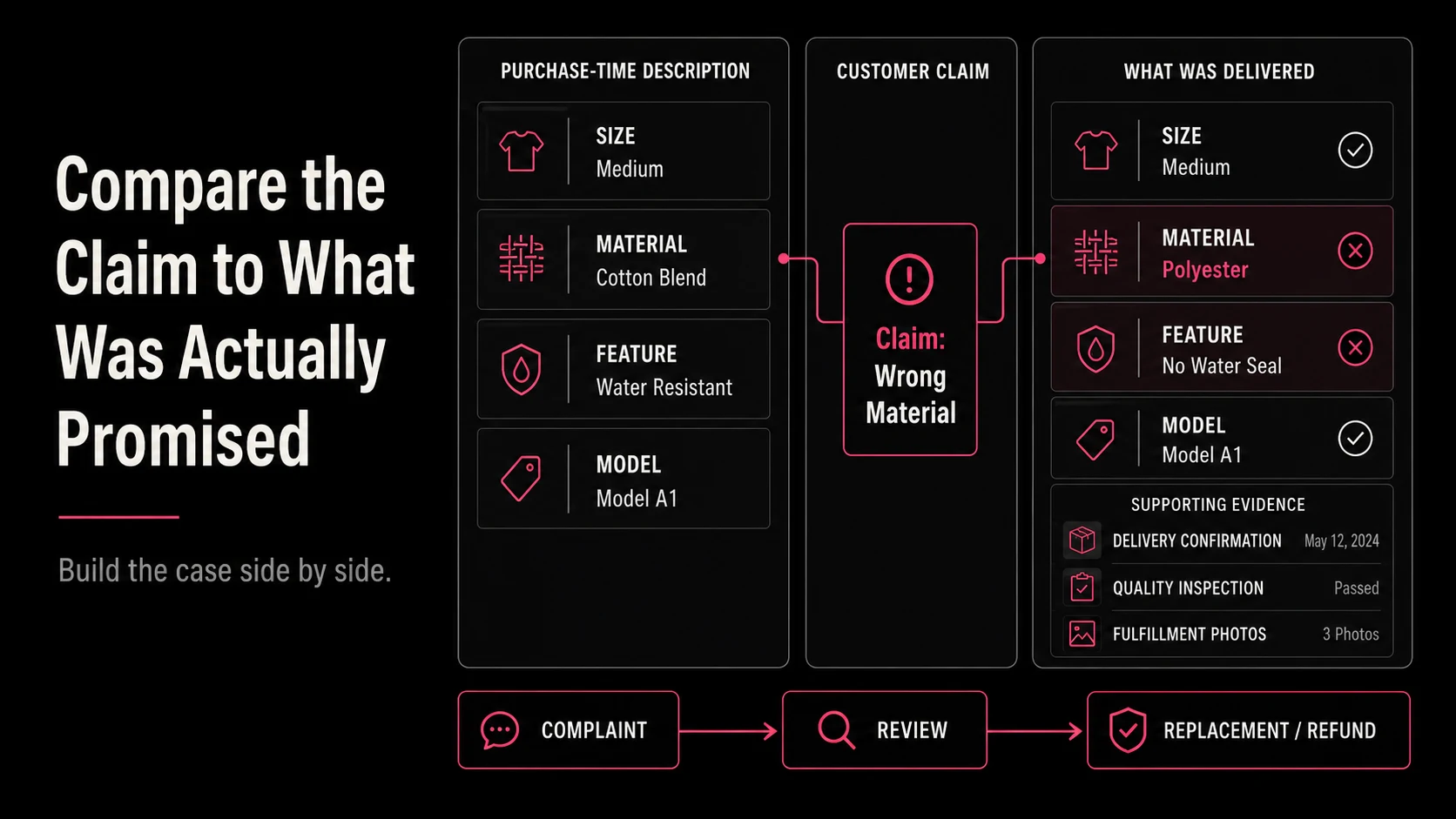
“Not as described” disputes are comparison cases. The reviewer needs to understand what was promised, what was delivered, what the customer said was wrong, and what the merchant did after the complaint. Generic claims that a product is “high quality” do little to answer a specific allegation.
The most useful merchant record is often a dated copy of the offer itself: product specifications, included items, size or compatibility details, service scope, delivery terms, refund conditions, and any limitation disclosed before checkout.
Archive the purchase-time description
Save the product page, plan comparison, service scope, images, size chart, compatibility list, and checkout summary that applied on the transaction date. If the page has since changed, use your CMS history, product export, or archived version instead of presenting the current page as though it were unchanged.
Highlight concrete promises: dimensions, model number, quantity, delivery format, included modules, support period, or feature access.
Define the customer complaint precisely
Separate “I did not like it” from a factual mismatch. A complaint about color preference is different from receiving the wrong model; slow onboarding is different from a promised feature being absent. The evidence should answer the actual claim.
If the customer provided photos, screenshots, or examples, keep them in the file. They may clarify whether the dispute concerns damage, quality, compatibility, missing components, or expectation mismatch.
Show what was delivered or provided
For physical goods, use packing records, SKU data, serial numbers, quality-control notes, and shipment details. For services, use the signed scope, milestones, deliverables, access records, and communications confirming work completed.
For digital products, preserve entitlement and usage data. Access logs do not prove that every marketing statement was accurate, but they can help establish that the promised product was delivered and used.
Document the attempted resolution
Show whether you offered troubleshooting, replacement, repair, partial refund, return instructions, or another remedy. If the customer refused a reasonable process, state that fact neutrally and attach the relevant exchange.
If your team failed to answer or made conflicting promises, fix the process instead of writing a rebuttal that ignores the record.
Use a side-by-side summary
A concise table can make the case easier to review: customer allegation, purchase-time promise, record of delivery, and merchant response. Keep the wording factual and attach the source record for each row.
The goal is not to overwhelm the reviewer with every document you possess. It is to make the disputed difference easy to evaluate.
Use the customer's exact defect claim as the comparison key
Before filing, create a three-line comparison for each disputed feature: what the purchase-time listing promised, what the customer says was received, and what the merchant record can actually verify. If the complaint concerns size, compatibility, condition, included accessories, or performance, use that exact attribute rather than a broad statement that the product matched the description.
If the merchant's own photos, support notes, or supplier information confirm a material mismatch, do not bury it beneath policy text. Record the remedy offered and use the case to correct the listing or fulfillment process that produced the mismatch.
Example: the listing was accurate except for one promised accessory
Imagine a camera kit advertised with body, battery, charger, strap, and memory card. The customer receives everything except the memory card and files a broad 'not as described' dispute for the full order. The merchant should not answer by proving the camera body was authentic and delivered. It should isolate the missing accessory, its value, the listing language, and the remedy offered after the complaint.
If support already offered to ship the missing card or issue a partial credit, that resolution belongs in the case. A narrow, item-specific response can support the portion of value actually delivered while acknowledging the merchant-side defect instead of pretending the order matched the listing in every respect.
Build a claim-by-claim comparison instead of a generic defense
A not-as-described dispute should be broken into the exact claims the customer made. If the buyer says the color, size, material, feature set, condition, or included accessories differed from the listing, create a comparison row for each allegation. On one side, preserve the listing or specification that applied at purchase. On the other, preserve fulfillment, serial number, variant, inspection, or support records that show what was actually supplied. This prevents the merchant from proving an easy point—such as authentic delivery—while ignoring the point the customer actually raised, such as a missing accessory or materially different specification.
Timing matters because listings and product pages change. A current webpage is not necessarily the version the customer saw. Preserve dated catalog exports, product-revision history, order-line metadata, or archived screenshots when your systems provide them. If the business substituted an item, changed a specification after checkout, or corrected a listing after complaints, say so. A case is more credible when it distinguishes the original promise from later edits instead of presenting the latest page as though it existed at the sale date.
Then account for remedies. Many not-as-described cases become amount disputes after the merchant offers a replacement, partial refund, repair, discount, or return. Record the offer, whether the customer accepted it, what was actually completed, and what value remained unresolved. If the merchant acknowledged one defect but delivered the rest of the order correctly, the response should not pretend there was no problem. It should identify the defect narrowly and reconcile the remaining value. That is both more accurate and easier to audit.
Before contesting, perform a skeptical review using only the customer's complaint and the exhibits. Ask whether an independent reviewer could tell what was promised, what arrived, what differed, and what the merchant did next. If one of those four steps is missing, add the underlying record rather than more argument. The strongest package is usually a short factual comparison supported by dated product, fulfillment, and communication records—not a long statement insisting that the item was 'as described' without showing the comparison.
Handle subjective quality complaints without pretending they are objective defects
Not-as-described cases sometimes involve subjective expectations rather than a measurable mismatch. A customer may dislike color tone, fit, taste, style, or creative output even though the product meets the written specification. The merchant should separate objective commitments from subjective preference. Show the exact purchase-time description and any measurable attributes, then document the customer's complaint without dismissing it. If the offer contained subjective promises such as premium, professional, or luxury, explain the concrete features used to support those claims rather than arguing that the customer simply has bad taste.
Where a reasonable return or remediation path existed, include it. A merchant can have a factually accurate listing and still create a preventable dispute if support ignores the complaint or makes the return process impossible. The case file should therefore show both conformity and resolution. That combination is more persuasive than a narrow attempt to prove the listing was technically correct while leaving the customer's post-purchase experience unexplained.
VERIFY CURRENT RULES
Primary references
Processor interfaces, reason-code mappings, filing windows, and network rules can change. Check the active dispute notice and current official documentation before submitting.