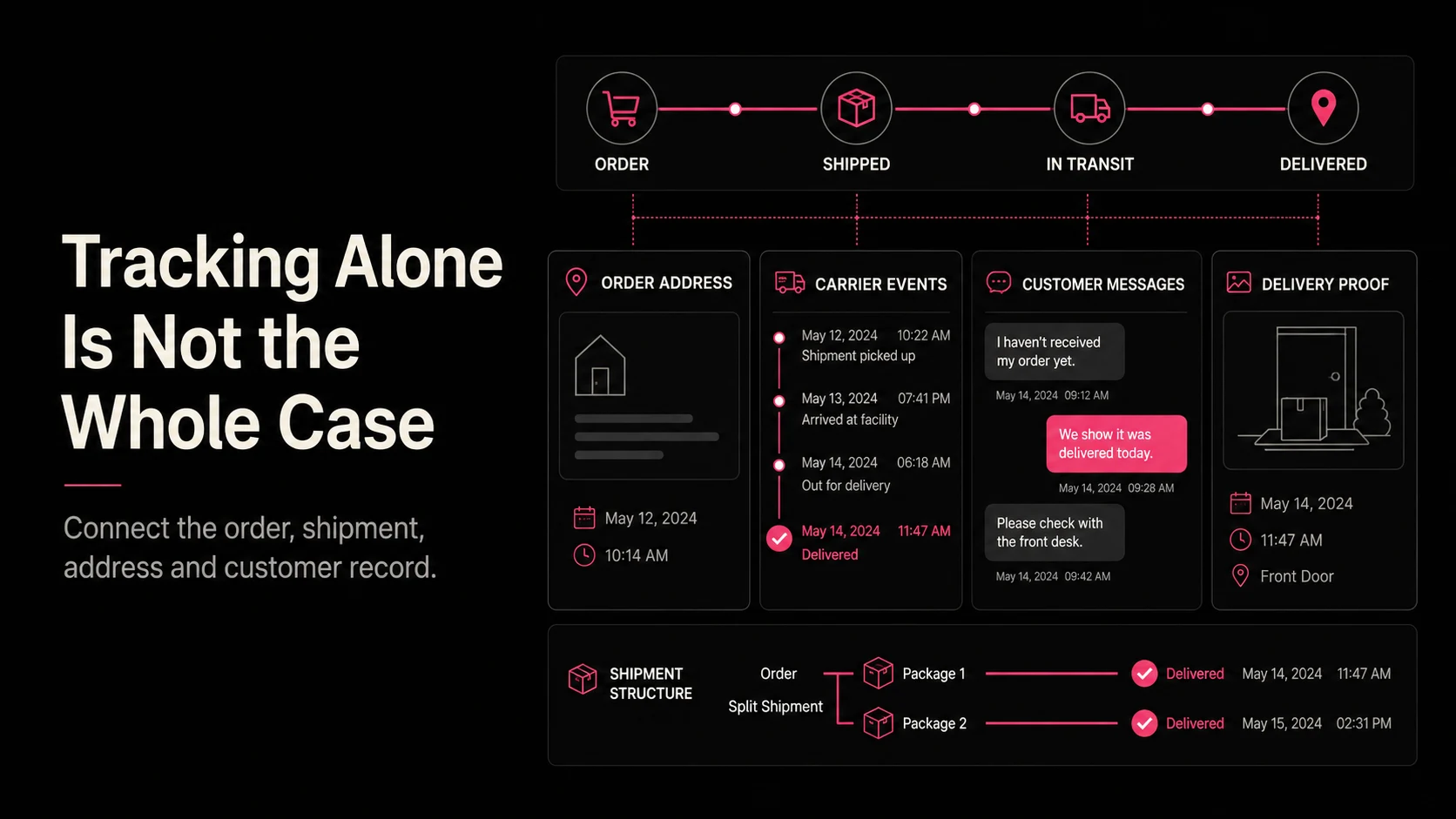
A delivered carrier status feels decisive to a merchant, but item-not-received disputes often turn on the details hidden behind that single word. Where was the package delivered? Was it the address on the order? Was it rerouted? Did the customer request the change? Was the order split across packages?
Build a last-mile record, not a screenshot of a green “Delivered” badge.
Start with the order address and shipping label
Save the checkout shipping address, shipping label, carrier, tracking number, ship date, and order ID. This establishes where the merchant intended the package to go.
If the warehouse changed the address, document why. An internal correction that sent the package to the wrong destination cannot be fixed by a successful carrier scan.
Preserve the complete carrier history
Use the full sequence of acceptance, transit, exception, reroute, hold, pickup, and final delivery. Destination information, signature, pickup identity, or delivery photo can be especially useful when available and appropriate.
A ZIP-only status may be too broad in dense areas. Include the level of destination detail the carrier record legitimately provides to the merchant.
A “delivered” carrier scan is the beginning of review, not the end. Verify the address from checkout, any post-purchase address change, carrier, tracking number, delivery date, service level, signature or photo if available, and whether the customer reported theft, misdelivery, or non-receipt to support. Connect the tracking record to the exact order and transaction so the reviewer is not expected to infer that the parcel belonged to this customer.
Explain address changes and carrier holds
If the customer asked to ship elsewhere after purchase, preserve the request and the merchant’s response. If the carrier redirected the package, include the event. If the customer picked up from a facility, save the pickup record.
Those facts help the reviewer understand why the final delivery path differs from the original order screen.
Handle split shipments item by item
For multi-package orders, label each tracking number against the items it contained. A merchant should not claim the whole order arrived because one of three packages shows delivered.
If the disputed amount relates to a missing item, focus the response on that item and any replacement or refund rather than burying it inside the value of the full order.
Use delivery disputes to improve fulfillment controls
Track wrong-address shipments, carrier loss, porch theft reports, missing scans, and customer-requested reroutes separately. The prevention response may be address verification, higher-value signature rules, better shipping communication, or a change in carrier service.
A delivered chargeback can be a customer-fraud case, but it can also be the first signal that the merchant’s last-mile data is too weak to investigate confidently.
Use the case to evaluate fulfillment controls. Repeated disputes from one carrier route, apartment building, freight forwarder, or high-value SKU may justify stronger confirmation, pickup options, or address-change review. For low-risk goods, extra signature requirements can create cost and delivery friction, so choose the control based on loss data rather than applying the strictest option to every shipment.
Example: carrier says delivered, customer reports apartment mailroom loss
A package is delivered to a managed apartment mailroom and the carrier provides a delivery scan but no individual signature. The merchant should show the order address, carrier event, building/mailroom context available in the record, and any customer acknowledgement or support follow-up.
Do not state that the customer personally received the parcel. If the merchant offered replacement or shipping protection, include that resolution. Delivery evidence is strongest when the merchant explains its limits instead of pretending the scan proves every post-delivery fact.
Investigate the last mile before treating 'delivered' as the end of the case
When tracking says delivered, connect that scan to the exact disputed items. Confirm order address, any customer-approved address change, shipping label, tracking number, package contents, and final carrier event. For split shipments, create one row per package. A green carrier status for one parcel does not prove that another parcel containing the disputed item arrived. For replacement shipments, keep the failed original and the replacement as separate fulfillment events.
Look at the delivery context. Apartment mailrooms, lockers, reception desks, neighbors, commercial receiving docks, and carrier pickup points can produce legitimate delivery records that do not name the purchaser. A signature may show that someone accepted the package without proving the cardholder was that person. A photo may corroborate location but is not identity proof. Explain what the carrier record actually establishes and avoid stronger claims than the document supports.
Then review the customer's post-delivery communication. Did they report a missing package immediately, ask about a parcel locker, file a carrier claim, later request a return, report damage, or acknowledge receipt? These events can distinguish theft-after-delivery, carrier misdelivery, wrong address, or a customer complaint that evolved. If the merchant replaced or refunded the order, include that remedy and reconcile the amount before deciding what remains worth contesting.
Use repeated 'delivered but not received' cases as fulfillment data. Segment by carrier, ZIP or region, apartment or commercial addresses, package value, delivery method, and fulfillment center. The root cause may be porch theft, poor address validation, unreliable carrier scans, inadequate pickup communication, or fraud. Different causes require different controls. A stronger chargeback packet is useful, but prevention comes from understanding why the final-mile record and customer experience diverge.
Use carrier claims as a second evidence stream when delivery is disputed
If the merchant opened a carrier loss or misdelivery claim, preserve the claim number, dates, carrier findings, and any reimbursement. A carrier paying a claim can suggest that the delivery record was not as conclusive as the top-line tracking status appeared. Conversely, a carrier investigation that confirms destination details can add useful context. Include the result honestly rather than selecting only the initial delivered scan.
Reconcile carrier reimbursement with customer resolution. If the merchant receives carrier compensation and also retains the customer's full payment despite confirmed delivery failure, the economic record deserves review. Dispute operations should connect logistics claims and payment disputes so one department's recovery does not hide another department's unresolved customer loss.
Separate theft-after-delivery from merchant delivery failure
A package can be correctly delivered and still disappear before the customer retrieves it. Porch theft, mailroom loss, or unauthorized locker access is different from shipping to the wrong address or a carrier misdelivery. Preserve destination detail, delivery method, customer report timing, and any carrier or property-management information the merchant legitimately receives. Do not automatically label the customer responsible simply because the scan says delivered. Internally classifying theft-after-delivery separately from merchant or carrier error produces better prevention decisions, such as signature options, lockers, pickup, or insurance for higher-risk orders.
A delivered scan should also be reconciled with what happened immediately after delivery. Check whether the customer contacted support about a missing parcel, porch theft, wrong unit, damaged package, or carrier error, and whether the merchant opened a carrier investigation or sent a replacement. Those events can materially change the story. If the merchant replaced the item, the dispute may now concern the replacement or a duplicate-value issue rather than the original shipment alone. If the carrier later corrected a misdelivery, preserve that correction rather than relying on the initial scan. Treating post-delivery events as part of the same timeline prevents the evidence packet from appearing selective and helps the reviewer distinguish merchant non-delivery from a loss that occurred after the carrier completed its recorded delivery.
VERIFY CURRENT RULES
Primary references
Processor interfaces, reason-code mappings, filing windows, and network rules can change. Check the active dispute notice and current official documentation before submitting.